
Listen to This Article:
High school culinary teachers and educators: get complimentary education and career counseling resources for your students.
We’ve all seen the cooking shows—a famous chef grabbing a pinch of this, a bit of that, a handful of the other, creating a mouth-watering dish. They make it appear spontaneous and carefree…and the meal always looks delicious.
Behind that seemingly effortless technique is a foundation of culinary math and science. Professional chefs rely on mathematical skills for recipe scaling, measurement conversions, and menu costing. They apply chemistry principles to understand how ingredients react during cooking. And they use biology and nutrition knowledge to create dishes that meet dietary needs and health trends.
Although cooks and chefs don’t need science or math degrees, they do need a working knowledge of the principles of culinary mathematics, food chemistry, and biology. If you’ve graduated high school (or if you’re about to), you might be pleased to know that you’ve already started learning some of the important skills you may need to succeed in the kitchen!
And with a well-rounded culinary arts program, students can build on those basics so they, too, might make cooking look easy.
How Math Is Used in Cooking
Ever sit through a high school math class and wonder, “When am I ever going to use this in my future?” If you plan on a future in food, then you’re going to use math every day!
Culinary Math: Measurements, Ratios, and Conversions
Cooks and chefs use math constantly, from measurements to ratios to conversions. What is a recipe, after all, if not an equation where component parts add up to create a whole?
Cooks are frequently adjusting recipe sizes to fit their needs. A full batch of the soup of the day may make 36 servings, but maybe it’s a busy holiday weekend, and you want to make extra. So you decide to increase the recipe by 50%. How will you figure out the appropriate amounts? With math!
Recipe Scaling Example
Scaling a Soup Recipe from 36 to 54 Servings (50% Increase).
| Ingredient | Original Amount (36 servings) | Calculation | Scaled Amount (54 servings) |
| Chicken stock | 12 cups | 12 × 1.5 | 18 cups |
| Diced onions | 3 cups | 3 × 1.5 | 4.5 cups |
| Carrots | 2 cups | 2 × 1.5 | 3 cups |
| Celery | 2 cups | 2 × 1.5 | 3 cups |
| Salt | 2 tbsp | 2 × 1.5 | 3 tbsp |
| Black pepper | 1 tbsp | 1 × 1.5 | 1.5 tbsp |
Or what if you’re making a recipe at a restaurant in the United States, but the original was created by a chef from London? How do you convert metric measurements to imperial? (Yes, there are smartphone apps that can help, but what if you can’t access your cell?)
How about if you’re cooking a 12-pound turkey? How long will you thaw it, and how long do you need to cook it? To figure it out, you’ll need to use culinary math.
Get the Culinary Education Planner & Checklist
Are you ready to embark on your journey to culinary school? Utilize this planner to craft a clear and actionable educational path.
Bakers and pastry chefs, too, use math every day. A baker may need to increase a recipe for a dozen cupcakes to twelve dozen. How will they go about it? Or they could wish to reverse-engineer a recipe based on the available ingredients. How many cupcakes can you make with 2.5 cups of milk? And how much baking powder and flour will you need now that you’ve adjusted the liquid?
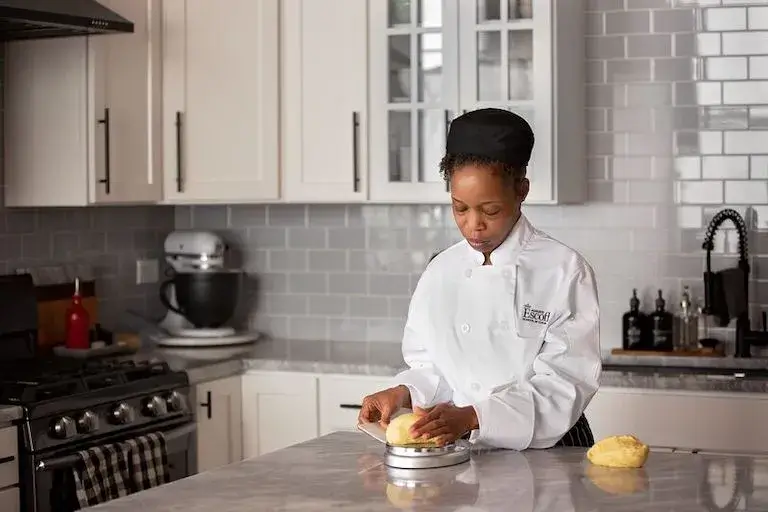
Culinary students explore how to apply mathematical principles to everyday cooking tasks like portioning and recipe scaling.
Escoffier graduate Ellen Doerr, who went from running a personal chef business to working as a culinary food specialist in food manufacturing, says understanding the math behind recipes was transformative.
“Escoffier taught me how to read a recipe and break down a recipe,” Doerr explains. “And it doesn’t matter what kind of food you’re cooking or what style or where you’re getting that recipe from, you have the formula and it’s all the same.”
Fortunately, while there are best practices for culinary math that you may be introduced to in culinary school, you probably already know the basics. Simple multiplication, division, and just a sprinkling of algebra are all you usually need to get started with kitchen calculations.
Menu Costing and Food Cost Calculations
There’s another number-heavy part of the chef’s work: the menu.
A chef must be able to calculate the exact food cost of every item on the menu, so they can assign a profitable price to it. The food cost is the sum total of all of the ingredients that go into a dish, from the substantial parts like protein and vegetables, to the oils and fats used during cooking, to the spices and even the garnish scattered on the plate.
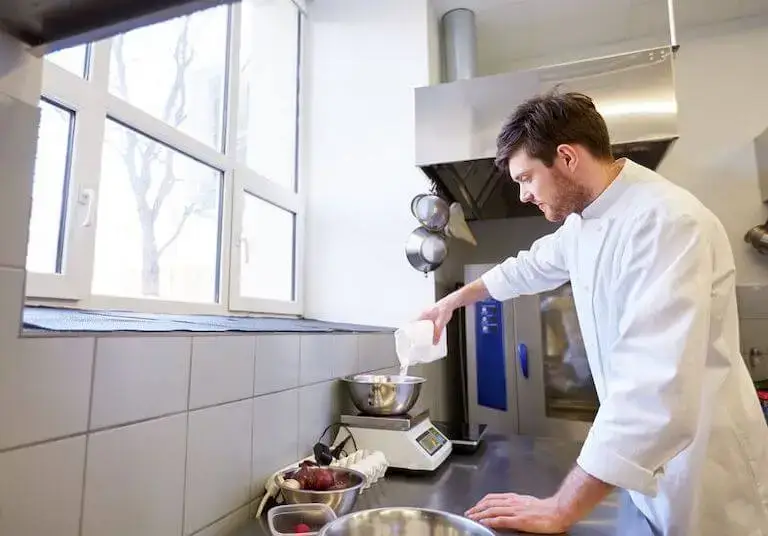
Professional chefs use math to convert measurements, adjust recipes, and scale costs.
To figure out these costs, chefs must keep track of how much they pay for each ingredient, and break those costs down into usable measurements—like the cost of a single ounce of chicken or flour.
Once the total cost of each dish is accounted for, the chef must figure out how much to charge so the menu price helps cover more than ingredients alone. The final price also needs to support expenses like labor, rent, utilities, equipment, and profit.
This is where food cost percentage comes in. Food cost percentage compares the cost of the ingredients in a dish to the price the customer pays. For example, if a dish costs $5.60 to make and the restaurant wants ingredients to account for 30% of the menu price, the chef can use this formula:
Menu Price = Total Food Cost ÷ Target Food Cost Percentage
For a grilled chicken entrée, that might look like this:
Food Cost Breakdown
Sample Menu Item: Grilled Chicken Entrée
| Ingredient | Amount | Cost per Unit | Total Cost |
| Chicken breast | 8 oz | $0.50/oz | $4.00 |
| Olive oil | 1 tbsp | $0.15/tbsp | $0.15 |
| Mixed vegetables | 4 oz | $0.30/oz | $1.20 |
| Herbs and spices | — | — | $0.15 |
| Garnish | — | — | $0.10 |
| Total Food Cost | $5.60 | ||
| Target Food Cost % | 30% | ||
| Calculated Menu Price | $18.67 |
Sound complicated? In Escoffier’s programs, students can discover how to apply the math they already know to costing and pricing their menus.
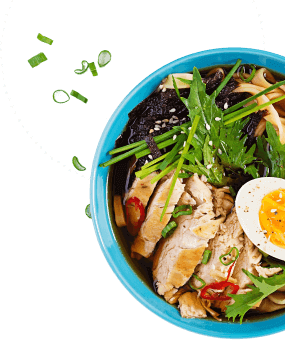
Chemistry in Cooking: Chemical Reactions in the Kitchen
When you sear a steak and smell that irresistible aroma, you’re witnessing chemistry in action. That’s the Maillard reaction—a complex series of chemical processes that create both color and dozens of flavor compounds.
Chemical reactions are foundational to all cooking. Knowing how to apply the reactions is helpful,and understanding why they work can take your culinary skill to the next level and open up doors to greater creativity.
Chemical Reactions in Cooking
| Chemical Process | What Happens | Culinary Applications | Result |
| Emulsification | Oil breaks into tiny droplets that disperse evenly through water | Vinaigrettes, hollandaise sauce, mayonnaise, bouillabaisse | Smooth, blended texture where oil and water stay mixed |
| Maillard Reaction | Amino acids and sugars react under heat to create new flavor and color compounds | Seared steak, roasted vegetables, toasted bread, browned onions | Rich brown color and complex savory flavors |
| Protein Denaturation (Sous Vide) | Muscle fibers shrink slowly at low temperature while retaining moisture | Sous vide meat, fish, and vegetables | Tender, juicy texture without moisture loss |
A common tool used in molecular gastronomy is spherification, using sodium alginate and a soluble calcium salt to create a gel around a liquid. These little orbs can add a tiny burst of flavor to each bite—plus they’re much more visually interesting than a drizzle of sauce! Spherification is a great skill to practice if you want to achieve this unique texture in your dish.
Sous vide cooking, the process of cooking food in vacuum-sealed packaging submerged in water, is another chemical process that chefs may find useful. The long, low-temperature cooking process allows the muscle fibers of meat to begin to shrink (making it more tender) while also minimizing the type of fiber contractions that occur at high heat and cause meat to lose its moisture. This is why sous vide cooking—when done correctly—leaves meat perfectly tender and juicy!
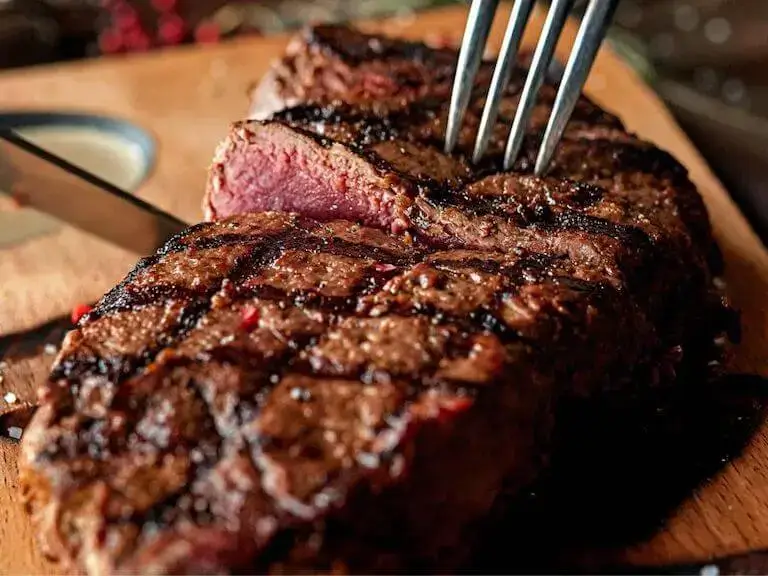
The Maillard reaction creates the rich brown crust and complex flavors in seared meat through chemical processes.
Emulsification is another fundamental chemical reaction in cooking—the process of breaking oil down into tiny droplets that disperse evenly through water. This reaction is what allows oil and water to blend in vinaigrettes, hollandaise, and bouillabaisse, creating smooth sauces and dressings that would otherwise separate.
When a cook understands how these reactions occur and why, it frees them up to experiment more and get creative in the kitchen.
Biology and Nutrition in Culinary Arts
Biology plays a huge role in the culinary arts, right down to the reasons we eat in the first place. All food is really just a way of providing the necessary energy (calories) to our bodies in order to fuel our cells. But within that simple job is an endless world of options.
Humanity has evolved together as a species, but we also each have our own individual bodies with unique nutrition needs and preferences. A basic understanding of human biology can help the cook or chef to satisfy food allergies and intolerances, cook to suit health trends, and understand why certain culinary preferences become more or less mainstream.
The rise in plant-based diets over recent decades is partially a result of research showing health benefits associated with vegetarian and vegan diets, including improved cardiovascular health markers and lower risk of cardiovascular disease and cancer.
The more we learn about the way our bodies react to food, the better we can fuel them—while also creating delicious meals that are a joy to eat.
Not a Math or Science Whiz? That’s Okay.
If you didn’t excel in math and science in high school—or you’ve forgotten everything you learned in these classes—don’t despair. A well-rounded culinary education can help you build a solid foundation in kitchen calculations and food chemistry.
And as you progress through your career, you can explore even more, diving deep into the math, chemistry, and biology of great cooking.
Think you have the passion to pursue a career in culinary arts? Turn that passion into a plan with an education from Auguste Escoffier School of Culinary Arts. Contact us to find out what you could discover at our Boulder, Austin, or online campuses!
DID YOU FIND THIS ARTICLE USEFUL? YOU MIGHT ENJOY THESE AS WELL.
- Is Culinary School Hard?
- Why Earn an Associate Degree in Culinary Arts?
- Culinary School Guide For High School Students and Parents
This article was originally published on February 3, 2016, and has since been updated.
FAQs
Math is used in cooking for recipe scaling, measurement conversions, and timing calculations. Chefs use multiplication and division to adjust recipe yields, convert between metric and imperial measurements, and calculate cooking times based on weight. Math is also essential for menu costing, where chefs calculate ingredient costs per portion to set profitable menu prices.
Chefs don’t need a chemistry degree, but understanding basic chemical reactions can improve cooking results and creativity. Chemical processes like emulsification (blending oil and water in dressings), the Maillard reaction (browning meat for flavor), and protein denaturation (tenderizing meat through sous vide) are fundamental to professional cooking. Knowing why these reactions work can allow chefs to experiment and troubleshoot recipes more effectively.
Bakers use math to scale recipes up or down, calculate ratios between ingredients, and adjust recipes based on available ingredients. For example, a baker might multiply a recipe for one dozen cupcakes to make twelve dozen, or work backward to determine how many cupcakes can be made with a specific amount of milk. Baker’s percentages and ratios are also used to maintain consistency across batches.
Food science can help chefs understand how ingredients interact, why cooking techniques work, and how to accommodate dietary needs. Knowledge of biology and nutrition can allow chefs to address food allergies, follow health trends like plant-based diets, and create dishes that are both delicious and aligned with guests’ nutritional goals. Understanding the science behind cooking can lead to better technique and more consistent results.
You don’t need to be a math expert to become a chef. Basic arithmetic covers most culinary math needs. Culinary schools can teach the practical math skills used in professional kitchens, including recipe scaling, conversions, and food costing. If math wasn’t your strongest subject in high school, a culinary education can help you build the specific numeracy skills needed for cooking.